Blog
A workshop found without a high street
Buyers search a maker, a town, a kiln — not a pedestrian street. How a potter shows up as a studio, not as a missing gift shop.

Reviewed 3 July 202610 min read
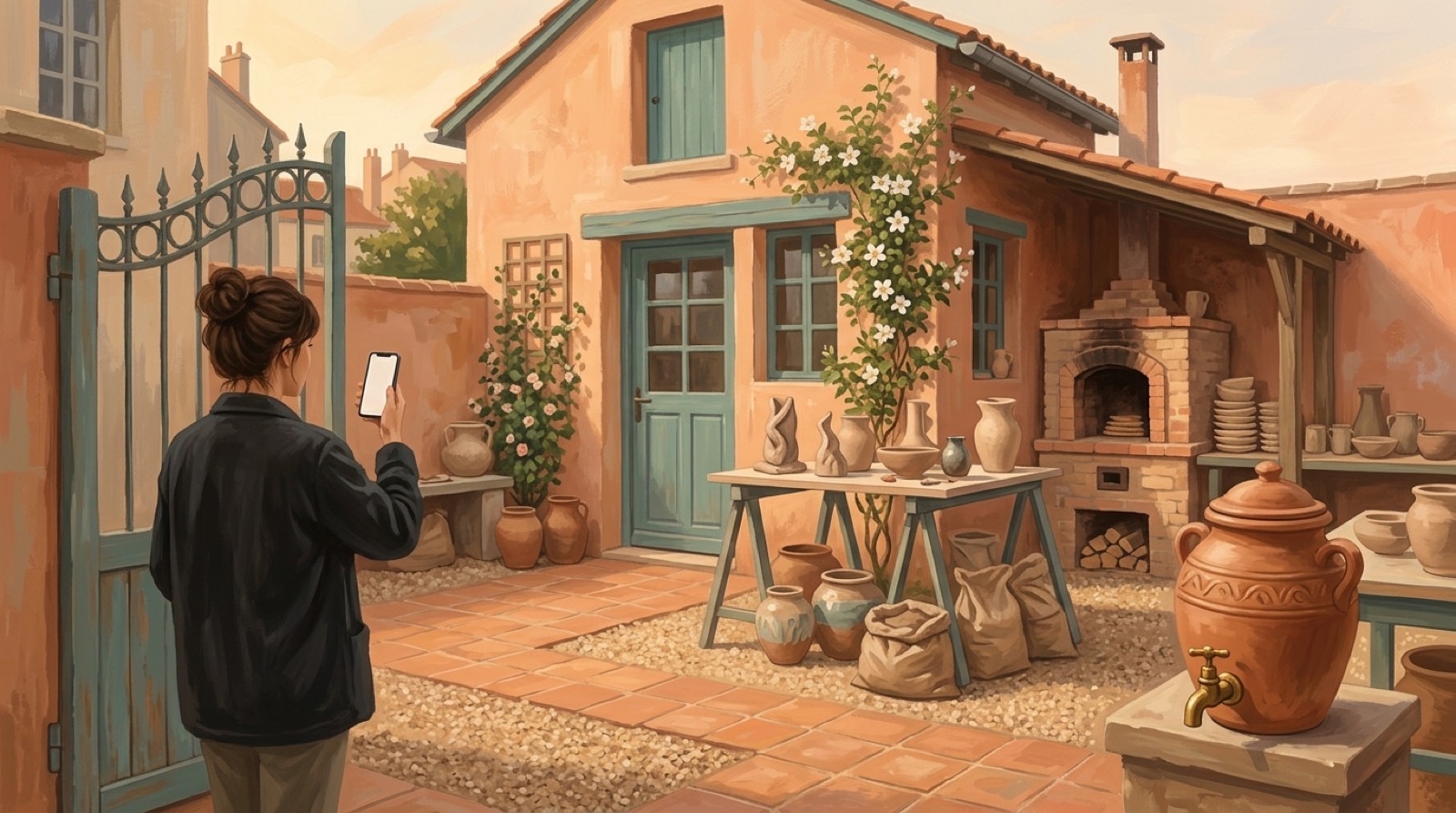
Someone who already owns one of your bowls will type your name. Someone who does not will type the town, “ceramist”, “pottery workshop”, sometimes “handmade mug”. Google then draws a short list. The gift shop on the pedestrian street has a window of imported bowls, a claimed listing, and a door the public walks into. You have a courtyard, a kiln, open days by appointment, and often a street that is not a high street at all.
That is not a reason to hide. It is a reason to be represented as a workshop, not as a missing boutique.
Screenshot pending: local-seo
Run pnpm screens with the app's local stack up to capture it. A potter’s Google listing edited in Artifluence.
What Google is actually comparing
Local results are relevance, distance and prominence — Google’s words, not a ranking-factor blog’s. Relevance is whether the profile matches “potter” or “ceramicist” for the person searching. Distance is how far you are from them. Prominence is how well-known the business appears: reviews, links, the rest of the web saying the same studio name.
A gift shop collects prominence by existing on a shopping street and in every “what to buy in [town]” list. A workshop collects it more slowly, and mostly through reviews, photographs of the work, and a complete profile. Pretending you are a shopfront does not help. Google’s representation guidelines want the name people would look up — the studio, or your name as it is on the card — not “Handmade Gifts & Pottery Lyon Centre” if the stamp on the foot of the piece says something shorter.
INSEE’s work on proximity retail is useful here, and we will not stretch it. The 2021 Première on town-centre versus outskirts clusters is about shops that receive walk-in trade, not about kilns. What it does show is that being off the pedestrian street is not, by itself, a death sentence for a local business. A courtyard atelier in a ZA, or a house with a plaque, is a real place of work. Inventing a high-street pin so you look like the boutique is the thing the guidelines exist to stop.
The two searches are not the same
“Atelier Delaunay ceramist” is a branded search. The listing has to have that name, that phone, a photograph of the work or of you at the wheel. If the listing is still in the name of a shared craft hall you left, or a market stall brand you no longer use, the buyer lands on the wrong maker.
“Pottery workshop near [town]” is a category search. The primary category has to be the job: potter, ceramicist, or the closest Google allows — not “gift shop”, not “souvenir store”, not “home goods store” because those get more searches. Secondary categories only if you actually teach, or you actually have a small shop that is open without an appointment. A catalogue of techniques in the title is how listings get edited back, or suspended. See what happens when the listing is suspended.
You are not a high-street window. Say so cleanly.
Many studios are at home, in a courtyard, or on an industrial estate. Three honest shapes:
People visit the atelier. Open days, collection of a commission, a short visit by appointment. That is premises. Put the address they can actually find, the hours you really sit there, a photograph of the door or the courtyard, not a stock interior of a gallery. Hybrid is allowed: an address and the towns you ship or deliver to, if both are true.
People do not visit. Commissions by message, sales at markets, collection at the next fair. Then the listing is closer to a service-area business than to a bakery. Hide an address nobody can walk into. Show the communes and postcodes you actually take work in, or the towns where the markets are regular. A fake window on the rue piétonne is a suspension risk, not a ranking tactic.
You do both. You receive on Thursday afternoon and you also sell at the Saturday market two towns over. Say both. Do not put the market square as your permanent address for the other six days.
The name, address and phone still have to match the directories, the site, and the Instagram bio, or the next listing Google builds from the web will disagree with yours.
What a stranger should see before they write
A photograph of a piece you made, or of your hands at the wheel — not a stock bowl. The kiln or the courtyard if that is honest. Hours that are “by appointment” if that is the truth, not “open 10–19” because the gift shop is. A description in two or three sentences: who you are, what you fire, whether you take commissions. Reviews from people who bought, or who commissioned, replied to.
We do not have a percentage for how often the gift shop outranks a courtyard studio on a given search. The free report can put your listing next to the neighbours Google already shows. It publishes nothing.
Marc Delaunay’s quote is on the potters page, because it is a real one. It is not copied here to decorate a ranking article.
The listing is the page a stranger sees before they ask for a price. Keep it as complete as the boutique’s, and as honest as the stamp on the clay.
Sources
- Tips to improve your local ranking on Google (accessed 7 September 2026)
- Guidelines for representing your business on Google (accessed 7 September 2026)
- Manage your business category (accessed 7 September 2026)
- Proximity retail: clusters thrive more on the outskirts than in town centres (INSEE Première 1858) (accessed 7 September 2026)