Blog
Potter photos: the piece, the hands, the kiln
A bowl you made, your hands at the wheel, the firing if it is honest. What belongs on a studio listing — and the stock still life that does not.

Reviewed 17 August 20269 min read
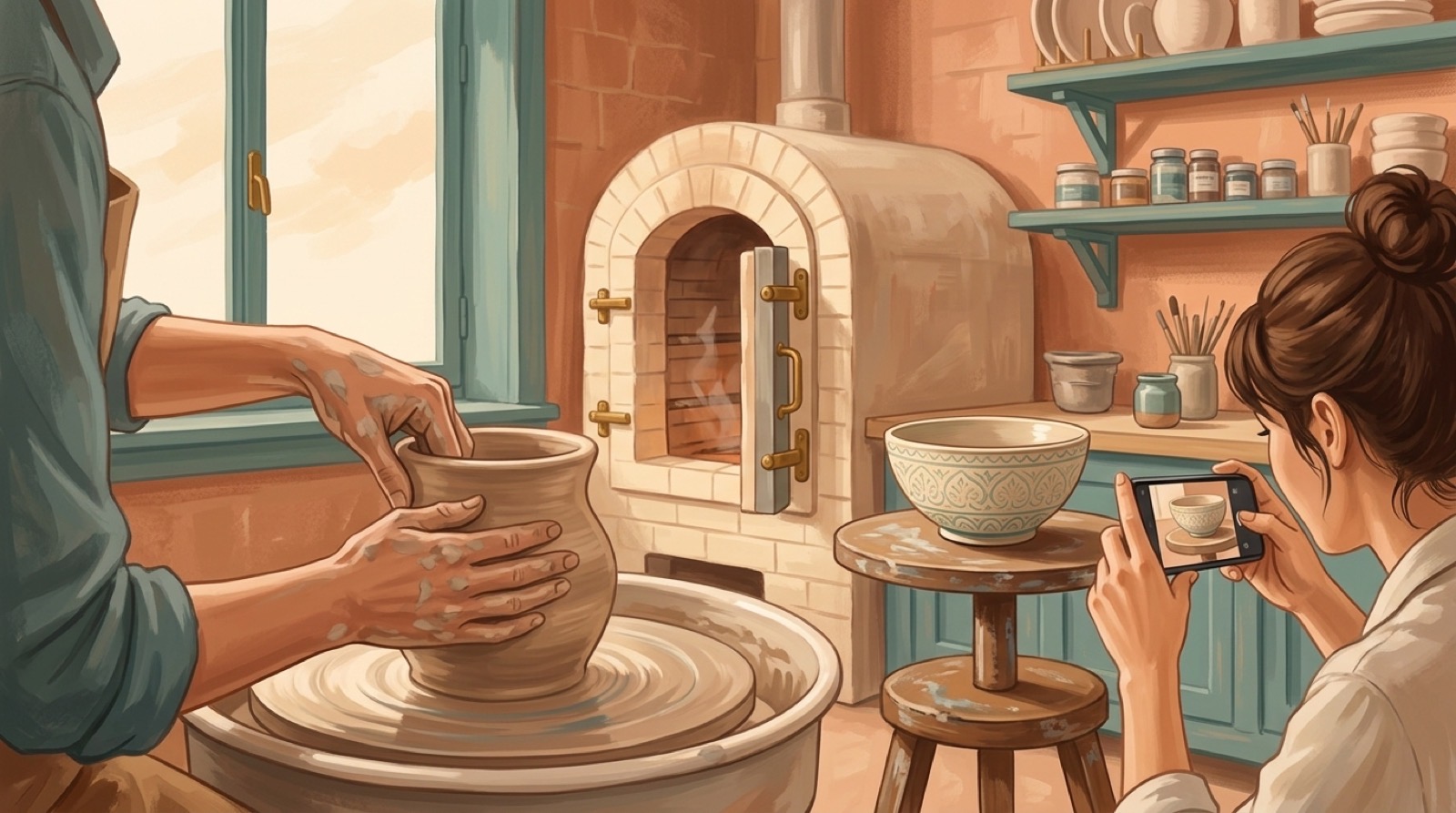
The gift shop photographs the window. You often have no window on a street anyone walks. The listing, Instagram, Pinterest still need pictures a stranger can trust. Three kinds, in that order: the piece, the hands that made it, the place it was fired if that place is yours to show.
Screenshot pending: local-seo
Run pnpm screens with the app's local stack up to capture it. Studio photographs in Artifluence.
The piece first
A logo is not a bowl. Buyers pick a maker by the work. One clear photograph of a piece you still have, or of a recent commission you are allowed to show, beats a rendered table styled with stock ceramics. Cover photos that are catalogue still lifes get the listing looked at as decoration. Google’s photo rules want the business, not a mood board.
Daylight, a plain surface, the foot if the stamp is how people recognise you. You do not need a studio flash. You do need the same piece not repeated twelve times from two centimetres apart.
If you work alone, do not upload a “team” of models holding cups. The representation guidelines and the photo policy meet on that point.
The hands and the kiln
Hands at the wheel, trimming, glazing — yours. Not a stock potter from another country. The kiln closed, the kiln open on a piece you fired, the courtyard on an open day. That is what tells a stranger this is a workshop, not a shop that buys in.
The listing photos piece is the general rule. Here the rule is: a buyer should recognise the work and believe the place.
Do not photograph another maker’s shelf at a shared hall and let it look like your production. Do not lift images from a gallery that showed you last year if the contract says the files stay theirs.
What you do not put up
A child’s face at a family workshop unless a parent said yes, in words. A customer’s dining room with your tableware unless they agreed. A cracked kiln you are ashamed of, presented as “authenticity”, if the real point is you have not taken a new picture in two years. A “before” of wet clay that is actually someone else’s throw from a reel you liked.
When a commission is sold and the buyer asked for privacy, take the room down. The piece on a plain cloth is usually enough. A letterbox or a house number in the background of an installation is not.
Cover, gallery, the phone
The cover is one frame a stranger sees before they open the profile: a piece, or the courtyard, in daylight. The gallery is five or ten more that are still yours to show — not the entire camera roll from 2022. Instagram can hold the process. The listing should hold the work they would buy.
You do not need a studio. A window, a grey cloth, the phone you already have. Wipe the lens. Turn off the portrait blur that invents a bowl that is not the one on the table. Do not grade the clay into a colour you cannot glaze again.
When a piece sells and you have no second, take it off the listing or caption it as a past work. A stranger who messages for a bowl that left in March is not a lead. They are a wasted morning. Markets are the same: last Saturday’s stall is a memory, not stock.
If you teach, photographs of students’ hands need the same consent as a commission in a dining room. A child’s face at a family workshop stays off Google unless a parent said yes, in words, not a nod over the wheel.
A logo on a white square is not a cover. A mood board of Japanese kilns you do not own is not a gallery. The stamp on the foot, if it is how people find you, can be a last photograph — close, sharp, yours. When you change the studio name, that stamp photograph has to change too, or the listing and the clay disagree.
If you only have three pieces this month, that is a listing. Forty catalogue still lifes would be a shop you are not. Wait for the next firing. The report will not tell you to upload a mood board to look complete.
What we do with them
You drop the files in. Artifluence can write the post. The listing still needs a human to decide which pieces are still available and which rooms are allowed on Google. We will not auto-publish a dinner table because the file was in the folder.
The potters page is where a real studio talks about morning photographs. This article is the pictures themselves. We do not have a count of “how many photos a ranking studio has”. When we publish a dated audit distribution, it will sit below.
Sources
- Business Profile photos & videos policy and posts content policy (accessed 7 September 2026)
- Guidelines for representing your business on Google (accessed 7 September 2026)